
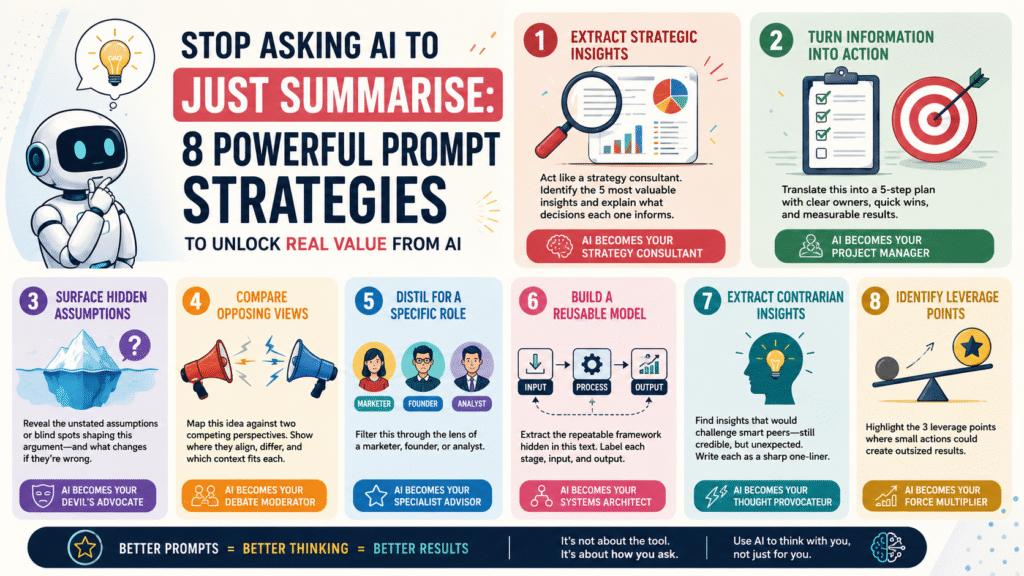
Most people still use AI in the simplest way possible they paste content and ask it to “summarise.”
But that only uses a tiny fraction of what AI can actually do.
Instead of treating AI like a summariser, you can turn it into a strategist, analyst, consultant, and even a decision-making partner.
Below are 8 powerful prompt strategies inspired by modern AI thinking that can completely change how you use AI in work, business, and learning.
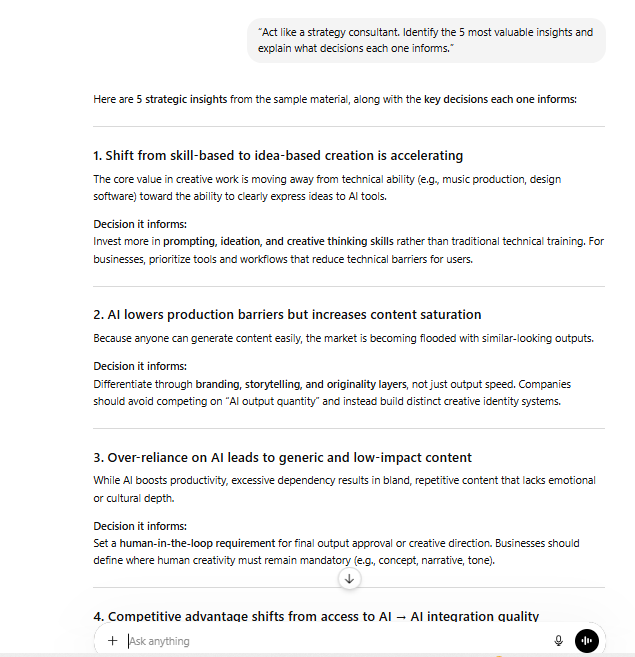
1. Extract Strategic Insights Like a Consultant
Instead of asking for a summary, go deeper:
Prompt:
“Act like a strategy consultant. Identify the 5 most valuable insights and explain what decisions each one informs.”
Why it works:
AI shifts from “what it says” to “what it means.”
Result:
- Clear business insights
- Decision-driven thinking
- Strategic clarity
Think McKinsey-style analysis on demand.
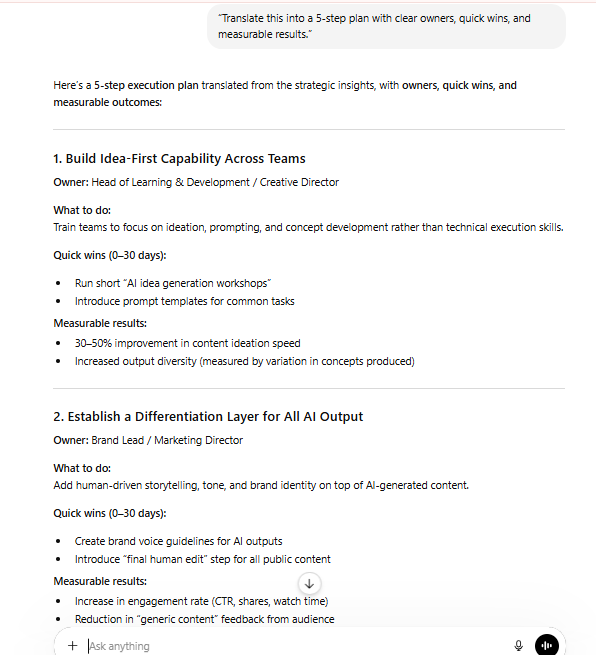
2. Turn Information Into Action Plans
Knowledge is useless without execution.
Prompt:
“Translate this into a 5-step plan with clear owners, quick wins, and measurable results.”
Why it works:
AI becomes your project manager.
Result:
- Actionable roadmap
- Clear responsibilities
- Faster execution
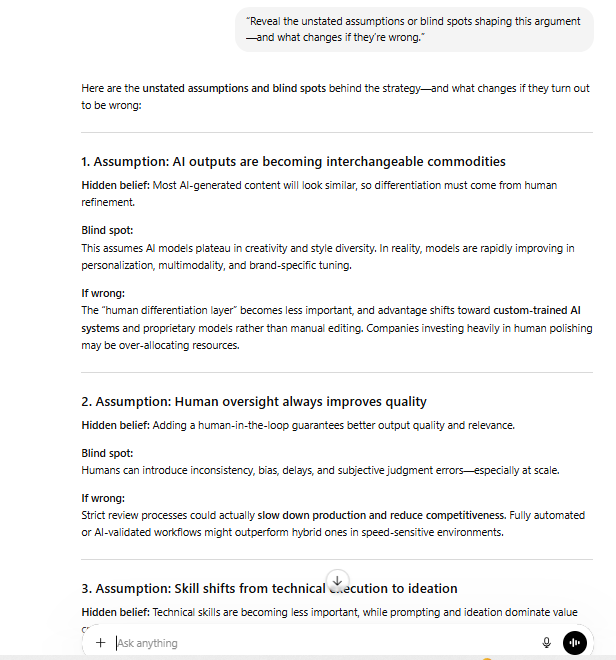
3. Surface Hidden Assumptions
Most arguments fail because of unseen assumptions.
Prompt:
“Reveal the unstated assumptions or blind spots shaping this argument—and what changes if they’re wrong.”
Why it works:
It forces critical thinking.
Result:
- Stronger decision-making
- Risk awareness
- Better problem-solving
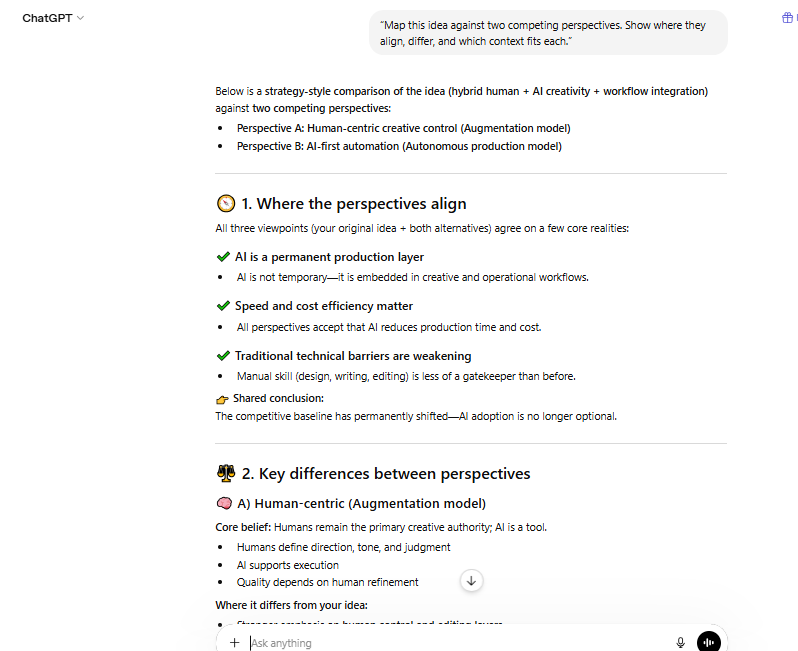
4. Compare Opposing Views
Don’t accept one perspective.
Prompt:
“Map this idea against two competing perspectives. Show where they align, differ, and which context fits each.”
Why it works:
You get balance instead of bias.
Result:
- Better judgment
- Reduced one-sided thinking
- Clear comparison of ideas
5. Distil for a Specific Role
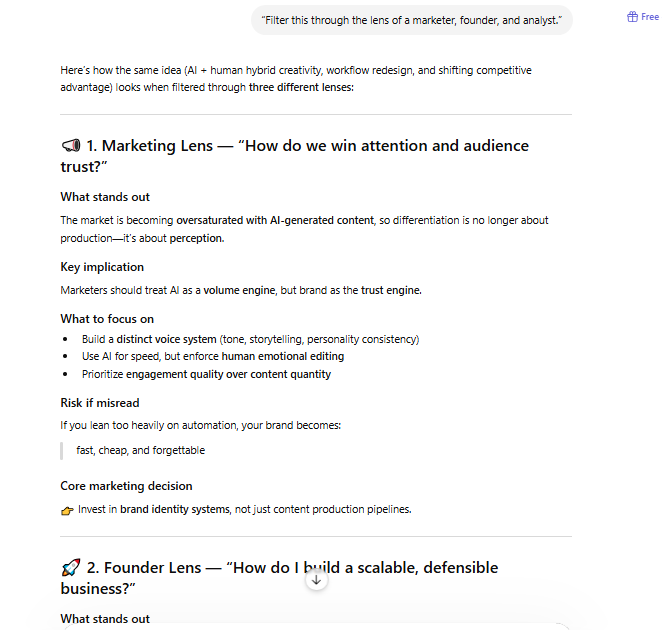
Same information, different impact.
Prompt:
“Filter this through the lens of a marketer, founder, and analyst.”
Why it works:
AI adapts to roles like a specialist.
Result:
- Marketing insights (conversion, reach)
- Business insights (growth, cash flow)
- Analytical insights (metrics, performance)
6. Build a Reusable Framework
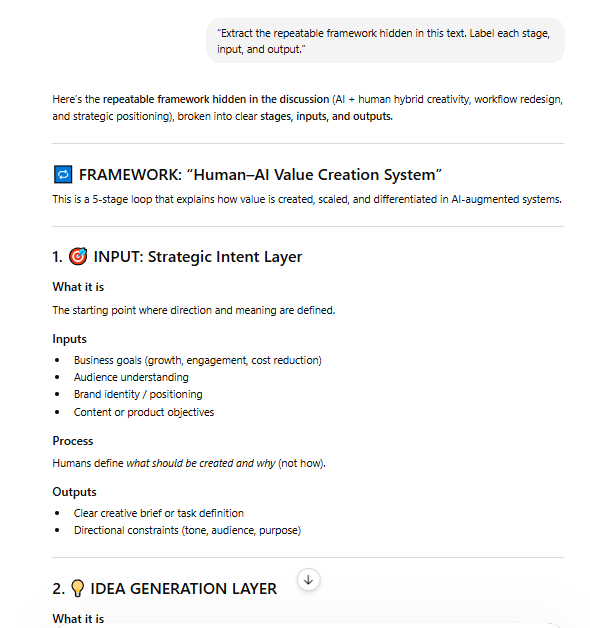
Turn knowledge into systems.
Prompt:
“Extract the repeatable framework hidden in this text. Label each stage, input, and output.”
Why it works:
You stop consuming information—you build systems.
Result:
- Structured thinking
- Scalable processes
- Long-term use of knowledge
7. Extract Contrarian Insights
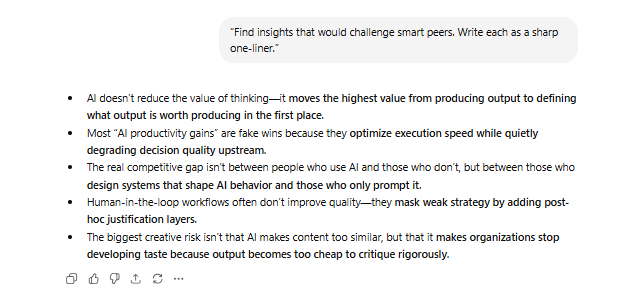
Go beyond obvious answers.
Prompt:
“Find insights that would challenge smart peers. Write each as a sharp one-liner.”
Why it works:
It forces originality.
Result:
- Unique perspectives
- Thought leadership ideas
- Strong content hooks
8. Identify High-Leverage Points
Focus on what actually matters.
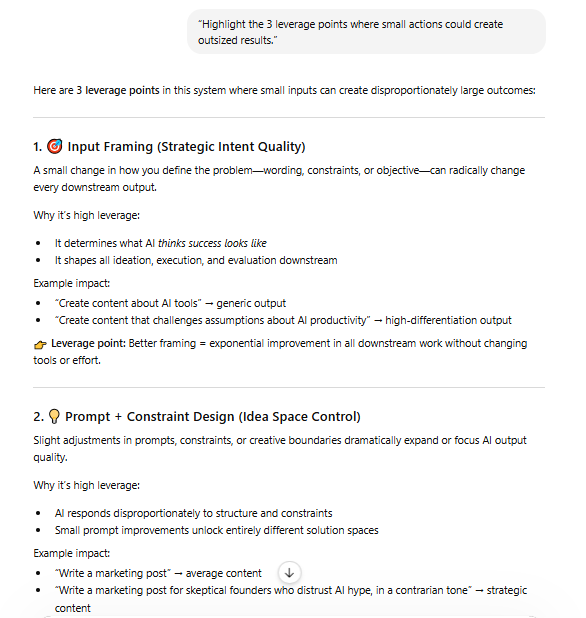
Prompt:
“Highlight the 3 leverage points where small actions could create outsized results.”
Why it works:
AI helps you focus on impact, not effort.
Result:
- Efficiency improvement
- Smarter prioritization
- Higher ROI actions
Final Thoughts
Most people are stuck using AI as a simple summariser.
But advanced users treat AI like:
- A strategy consultant
- A project manager
- A systems architect
- A debate partner
The difference is not the tool.
It’s the prompt.
If you upgrade how you ask questions, you upgrade the quality of every answer you get.