
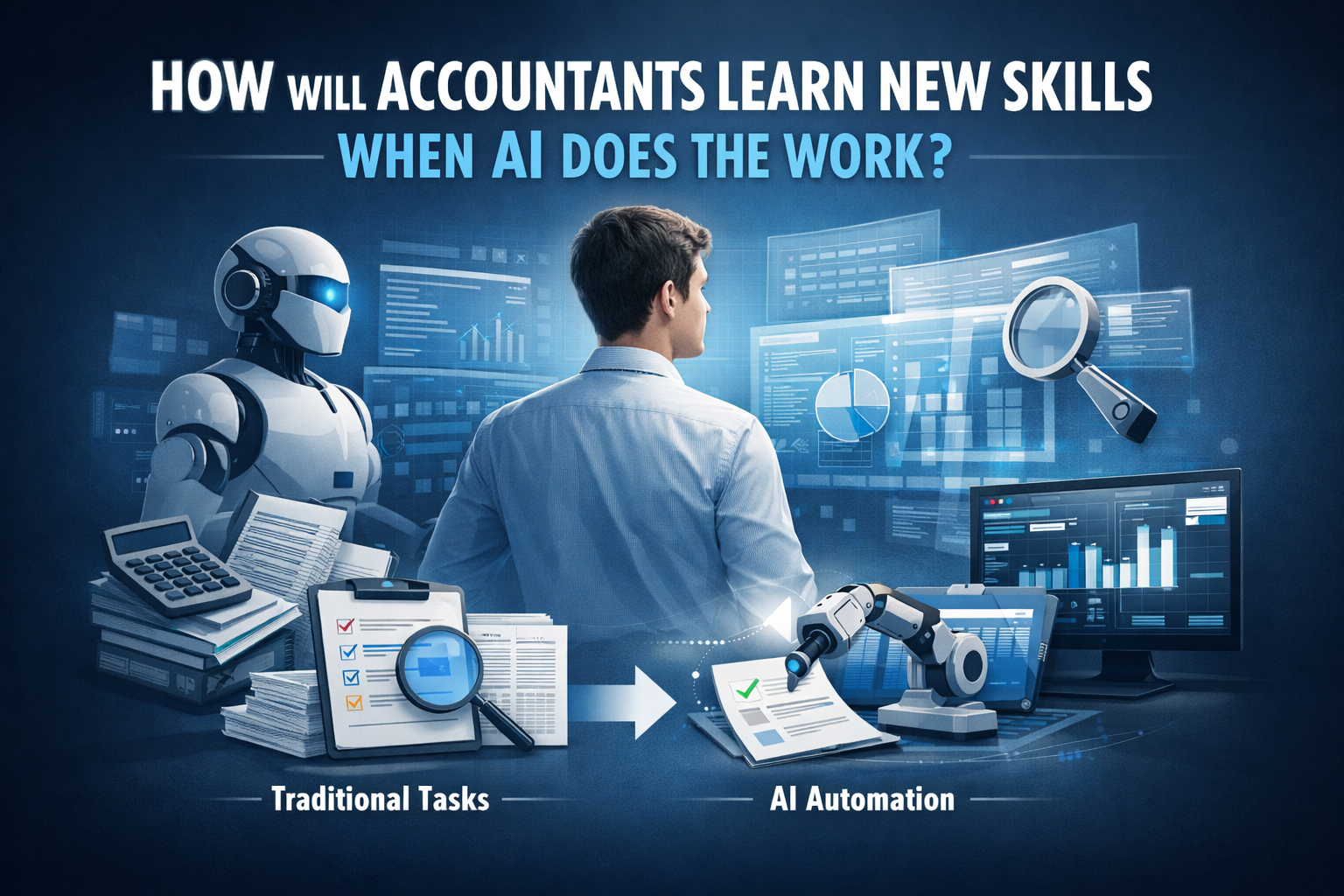
How will accountants learn new skills when AI does the work? As artificial intelligence continues to automate traditional accounting tasks, this question is becoming more urgent for firms, educators, and professionals.
For decades, accountants developed their skills by performing repetitive, structured tasks. Junior auditors learned by checking invoices. Staff accountants learned by reconciling accounts. Managers refined their expertise by reviewing the work of juniors.
Today, many of these foundational tasks are automated.
AI-powered audit tools can analyze thousands of transactions in seconds. Automated reconciliation systems can match entries instantly. Smart review tools can identify inconsistencies before a human even sees them.
If machines are doing the work that once trained professionals. How will the next generation gain experience?
The answer is not less training. It is different training.
The Shift: From Execution to Supervision
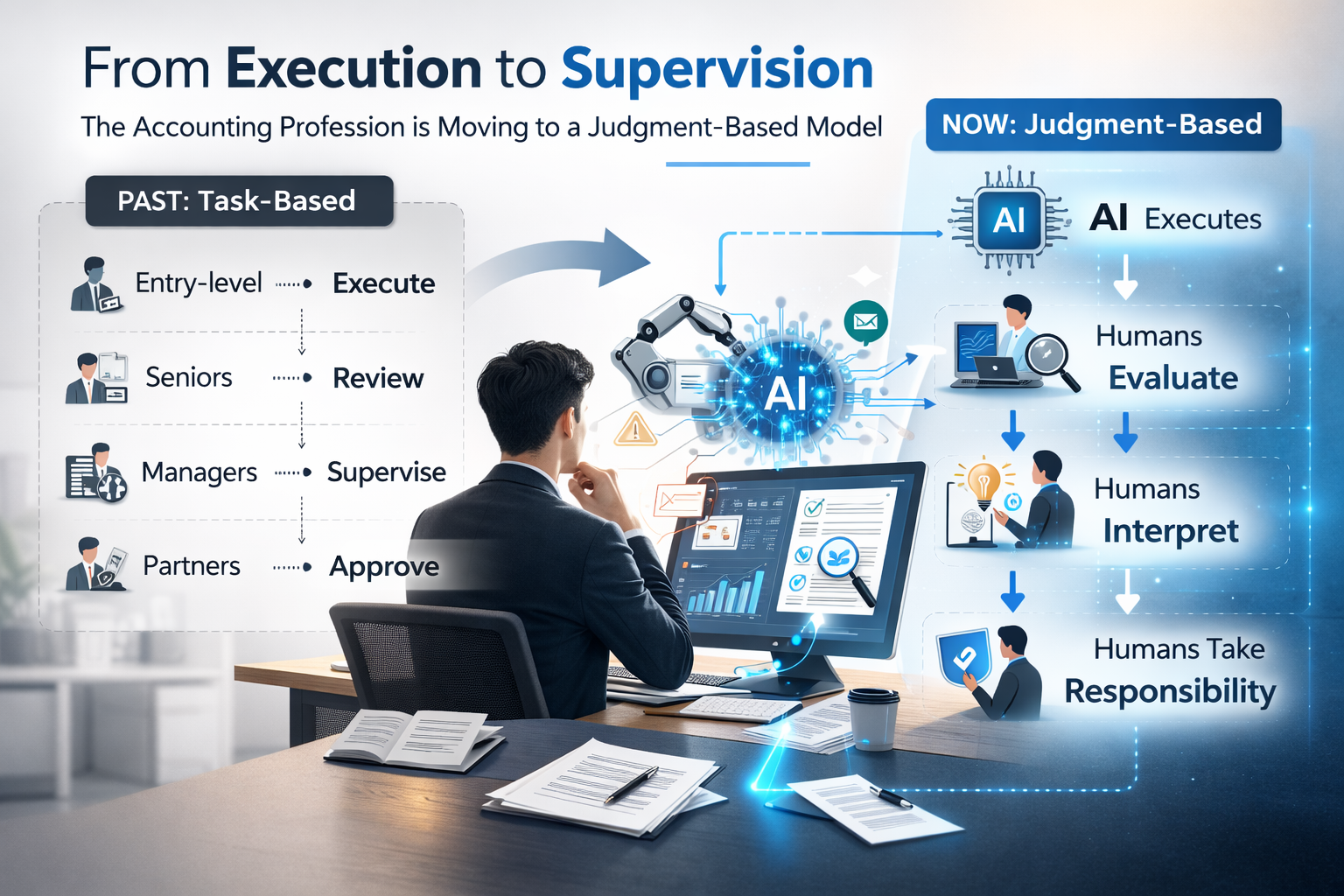
The accounting profession is moving from a task-based model to a judgment-based model.
In the past:
-
Entry-level staff executed procedures.
-
Seniors reviewed.
-
Managers supervised.
-
Partners approved.
Now:
-
AI executes.
-
Humans evaluate.
-
Humans interpret.
-
Humans take responsibility.
This shift changes everything.
When AI performs vouching, reconciliation, or analytical review, the accountant must understand:
-
Why the procedure exists.
-
What risk it addresses.
-
What could go wrong.
-
Whether the output makes sense.
Supervising AI requires deeper knowledge than performing routine steps. Professionals must understand the underlying logic, not just the process flow.
Why Conceptual Mastery Matters More Than Ever
Memorizing procedures is no longer enough.
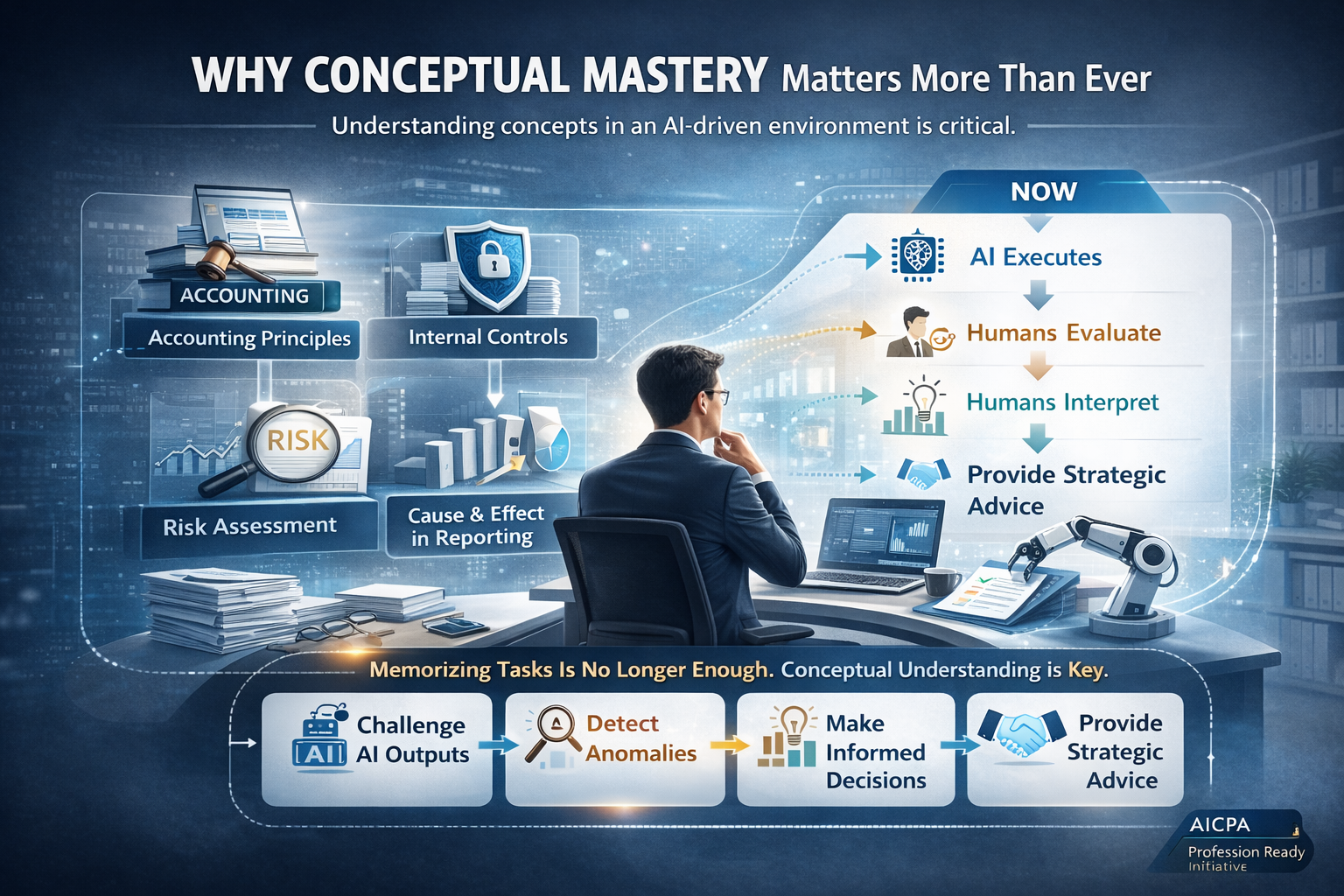
In an AI-driven environment, accountants must understand:
-
Core accounting principles.
-
Internal control frameworks.
-
Risk assessment logic.
-
Cause-and-effect relationships in financial reporting.
For example, knowing how to calculate a lease entry is useful. But understanding why lease classification affects financial ratios and investor perception is far more valuable.
Conceptual mastery allows professionals to:
-
Challenge AI outputs.
-
Detect anomalies.
-
Make informed decisions.
-
Provide strategic advice.
This is why professional bodies like the AICPA are investing in research initiatives such as the Profession Ready Initiative, focusing on closing early-career skill gaps and anticipating future competency requirements.
The profession is preparing for where it is going, not where it has been.
AI Is Reshaping Every Level of the Career Ladder
AI is not only affecting junior roles.
It can:
-
Assist with review processes traditionally handled by managers.
-
Identify risk indicators typically flagged by senior auditors.
-
Generate draft reports that once required partner-level input.
This means the learning process is compressing.
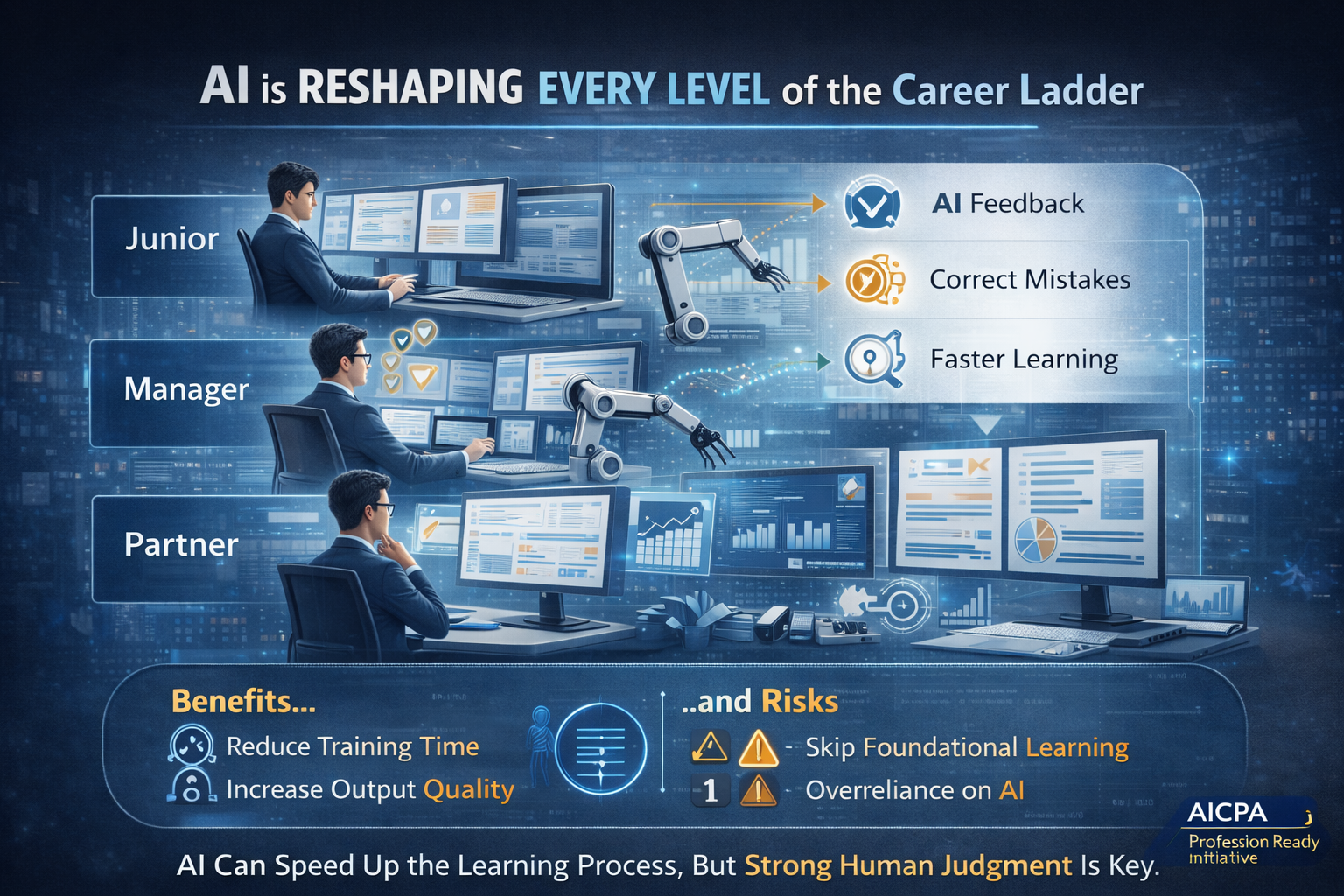
Junior staff may now:
-
Receive instant AI feedback.
-
Correct mistakes independently.
-
Deliver higher-quality outputs earlier in their careers.
However, this acceleration comes with risk.
If professionals skip foundational understanding and rely solely on AI-generated results, they may lack the critical thinking required to detect errors.
AI can enhance growth but only when guided by strong human judgment.
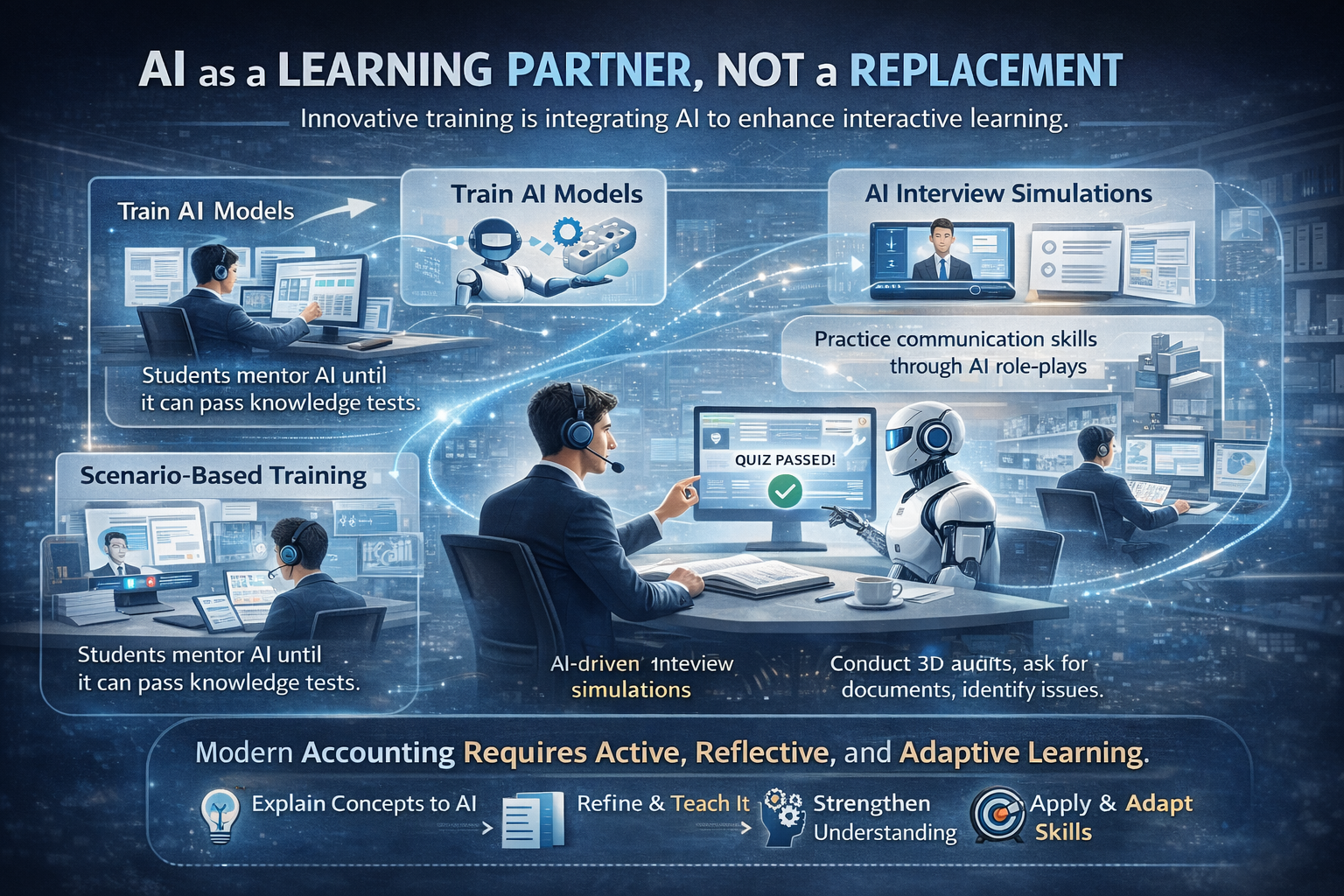
AI as a Learning Partner, Not a Replacement
Forward-thinking educators and firms are not removing AI from training. They are integrating it.
Instead of passive learning, training is becoming interactive.
Examples include:
-
Students training AI models until they can pass knowledge tests.
-
AI-driven interview simulations to practice communication skills.
-
Scenario-based learning environments that mimic real audit situations.
This approach transforms AI into a training partner.
When professionals must explain concepts to AI or refine its outputs, they strengthen their own understanding.
Learning becomes active, reflective, and adaptive. Exactly the skills required in modern accounting.
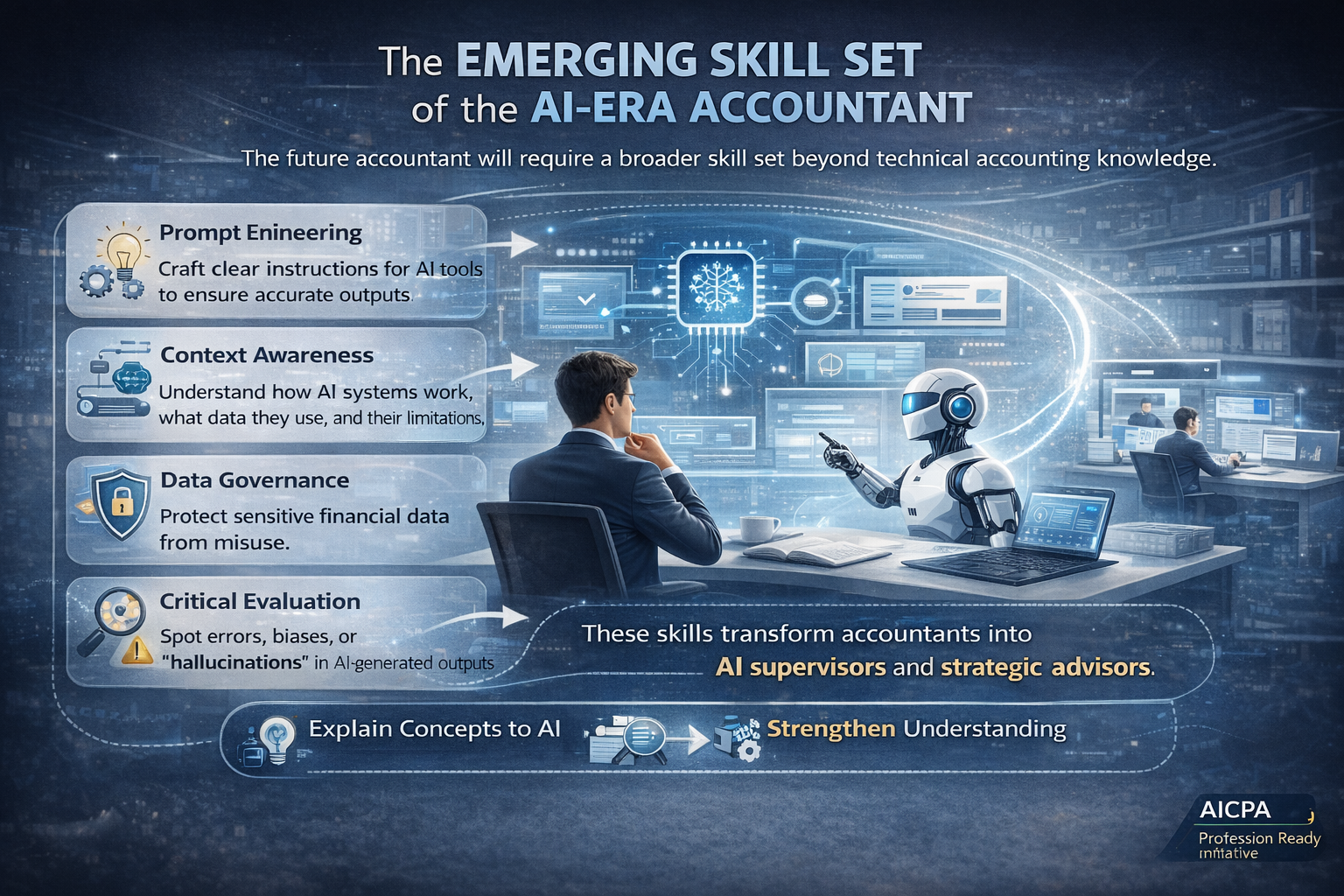
The Emerging Skill Set of the AI-Era Accountant
The future accountant will require a broader skill set beyond technical accounting knowledge.
Key competencies now include:
1. Prompt Engineering
Understanding how to communicate clearly with AI systems. Poor instructions lead to poor outputs.
2. Context Awareness
Knowing how AI tools are structured, what data they use, and their architectural limitations.
3. Data Governance
Ensuring sensitive financial information is protected and used appropriately.
4. Critical Evaluation
Recognizing hallucinations, biases, or incomplete analysis generated by AI.
5. Ethical Oversight
Maintaining accountability. AI can assist decision-making, but responsibility remains human.
These skills transform accountants into AI supervisors and strategic advisors.
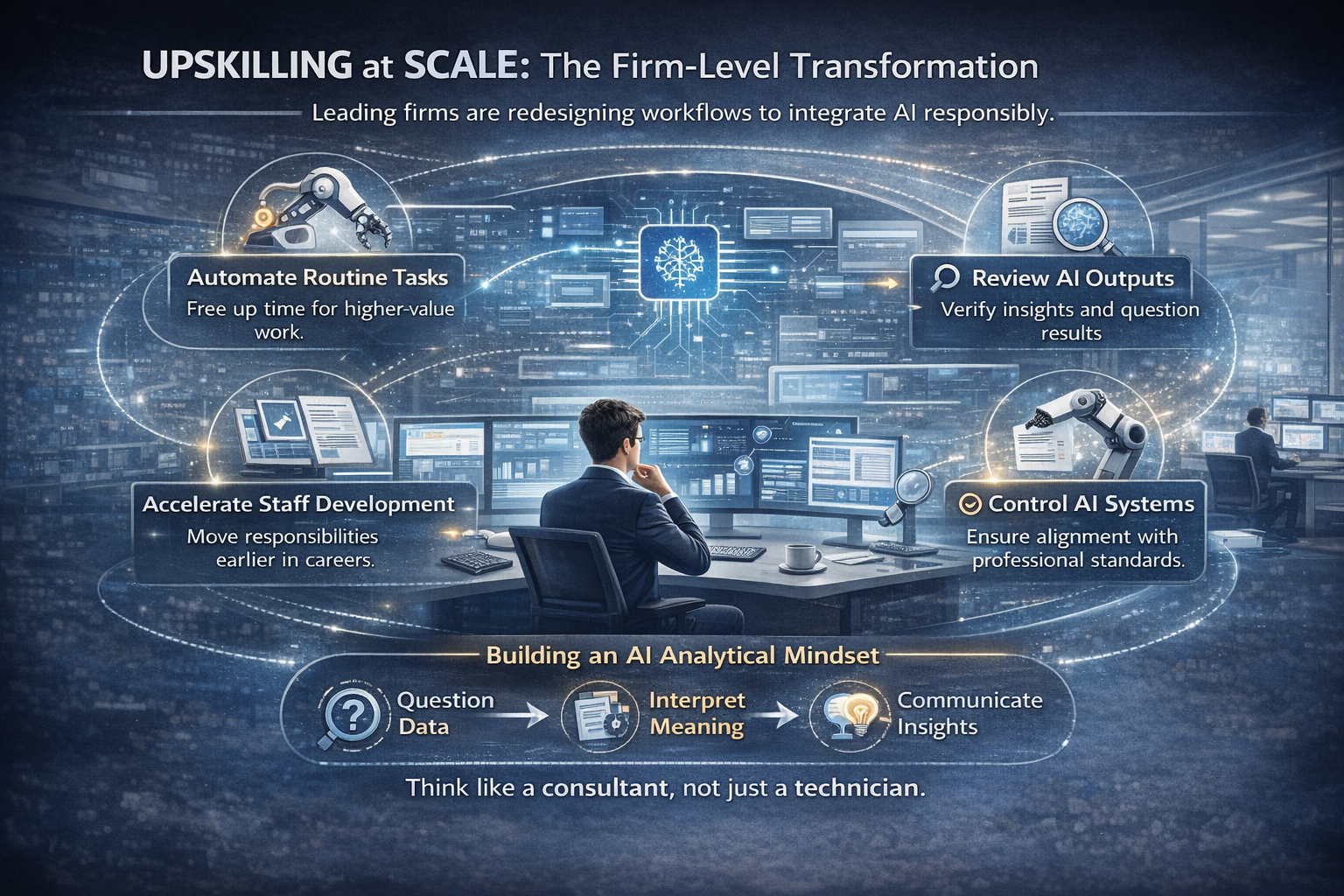
Upskilling at Scale: The Firm-Level Transformation
Leading firms are redesigning workflows to integrate AI responsibly.
Common strategies include:
-
Automating repetitive tasks to free time for higher-value work.
-
Moving certain responsibilities earlier in careers to accelerate development.
-
Creating controlled AI systems trained on verified professional standards.
-
Establishing review frameworks to validate AI outputs.
The goal is not just efficiency.
It is building an AI analytical mindset. The ability to question results, interpret data meaningfully, and communicate insights clearly to clients, CEOs, and boards.
The modern accountant must think like a consultant, not just a technician.
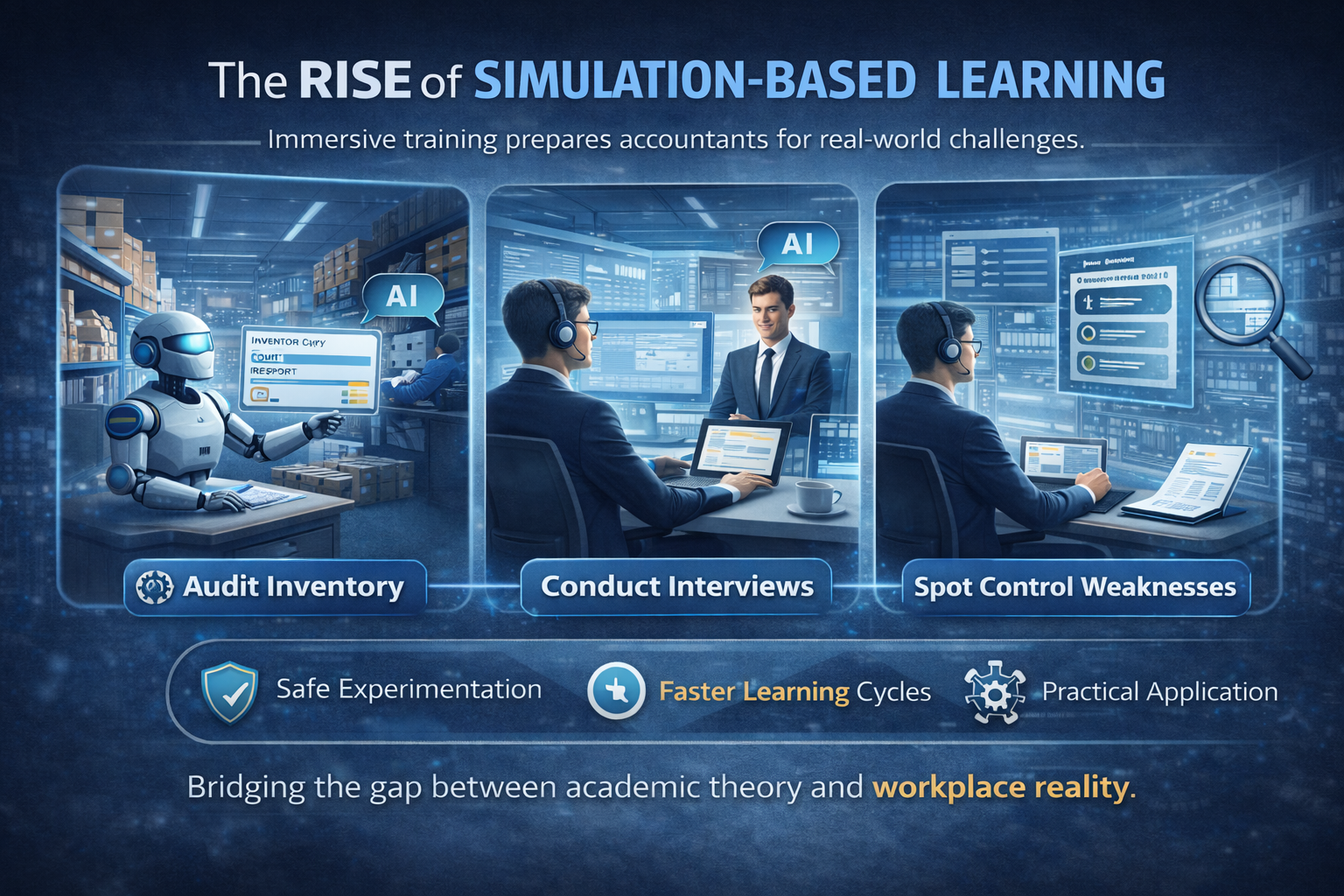
The Rise of Simulation-Based Learning
Traditional learning often relies on textbooks and lectures.
Future learning may rely on immersive simulations.
Imagine:
-
Auditing inventory inside a virtual warehouse.
-
Interviewing AI-generated management personas.
-
Identifying internal control weaknesses in real-time scenarios.
Simulation-based training offers:
-
Safe experimentation.
-
Faster learning cycles.
-
Practical application without real-world risk.
This bridges the gap between academic theory and workplace reality.
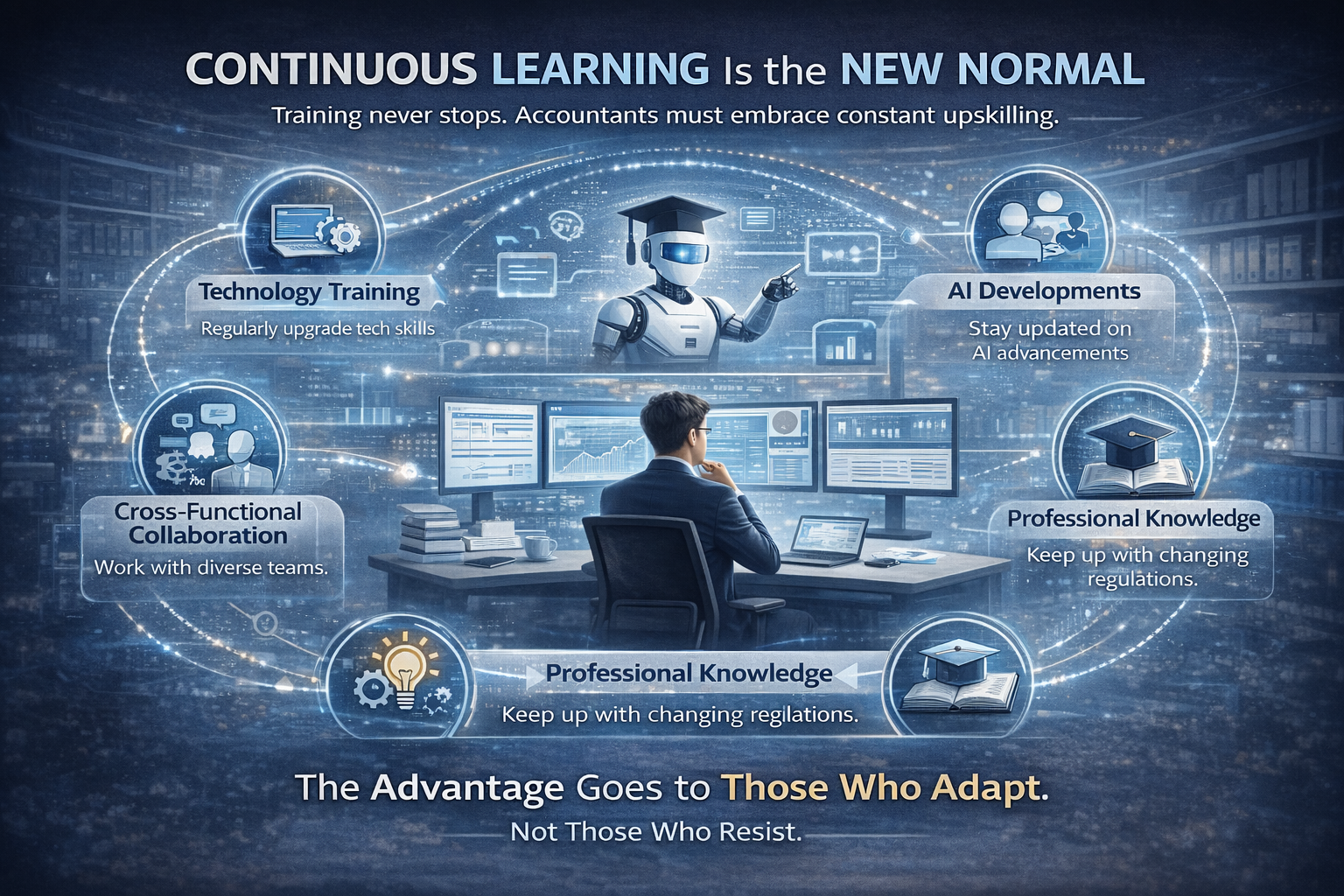
Continuous Learning Is the New Normal
One important truth remains, training will never be “complete.”
Technology evolves rapidly. Regulations change. AI models improve. Accountants must embrace continuous upskilling.
This includes:
-
Regular technology training.
-
Cross-functional collaboration.
-
Staying informed about AI developments.
-
Updating professional standards knowledge.
The competitive advantage will not belong to those who resist AI but to those who adapt with it.
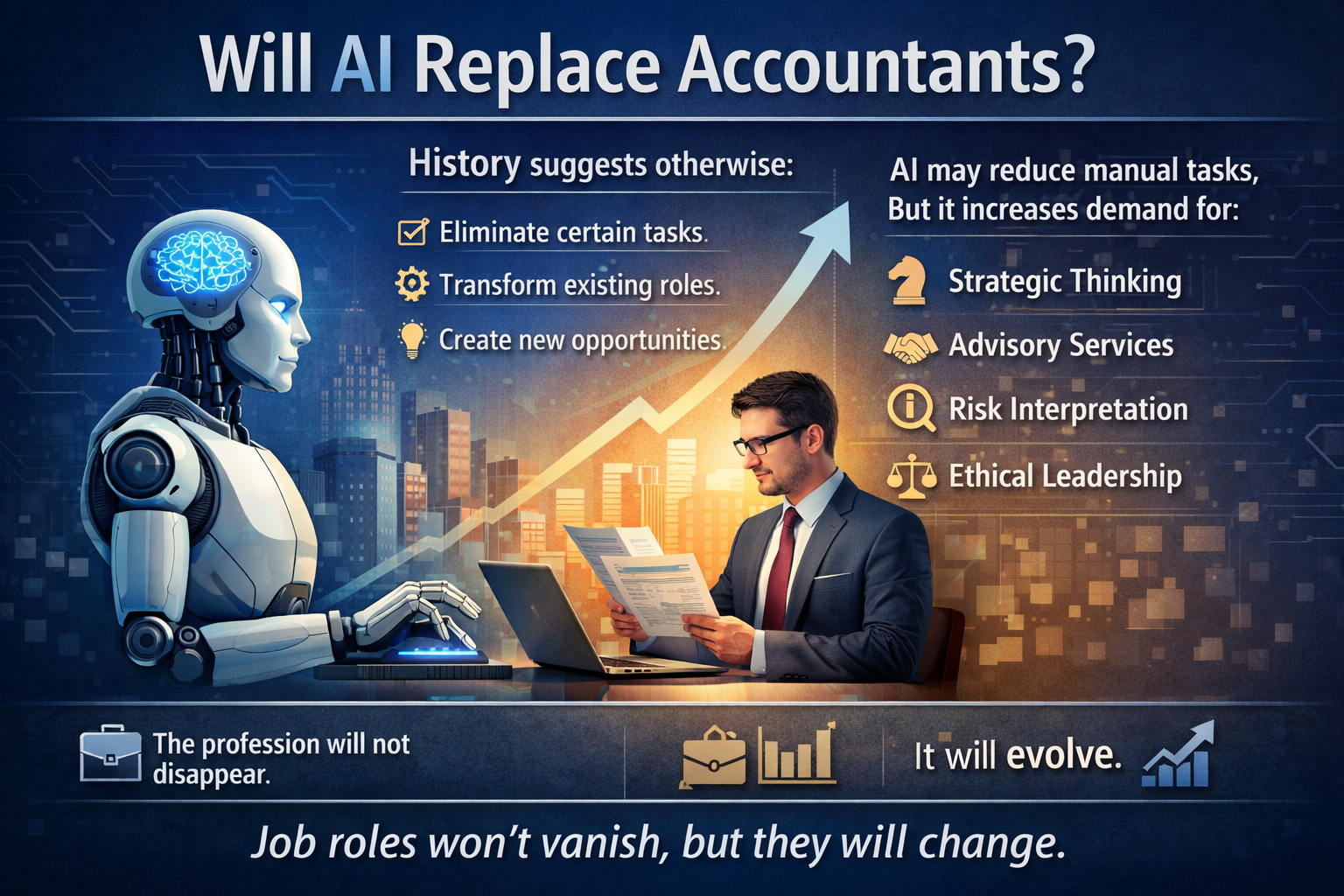
Will AI Replace Accountants?
History suggests otherwise.
Technological revolutions typically:
-
Eliminate certain tasks.
-
Transform existing roles.
-
Create new opportunities.
AI may reduce manual processing work. But it increases demand for:
-
Strategic thinking.
-
Advisory services.
-
Risk interpretation.
-
Ethical leadership.
The profession will not disappear.
It will evolve.
There may not be massive job loss but there will be massive job change.
The Future of Accountancy Training
To succeed in this transition, academia and industry must collaborate.
The new model of training will prioritize:
-
Deep conceptual understanding over task repetition
-
Supervision and governance of AI systems
-
Simulation-based and experiential learning
-
Cross-level knowledge sharing
-
Communication and consulting capabilities
-
Lifelong learning culture
Accounting is moving from transaction processing to strategic value creation. And AI is accelerating that transformation.
Conclusion
AI is not removing the need for accountants. It is redefining what it means to be one. How will accountants learn new skills when AI does the work?
They will learn through supervision, simulation, conceptual mastery, and continuous upskilling. The future accountant will not compete with AI.
They will collaborate with it.
If training evolves in the right direction, AI will not weaken the profession. It will elevate it.
Credit
Adapted and inspired by insights from:
Hannah Pitstick, Journal of Accountancy (March 2026)
“How Will Accountants Learn New Skills When AI Does the Work?”